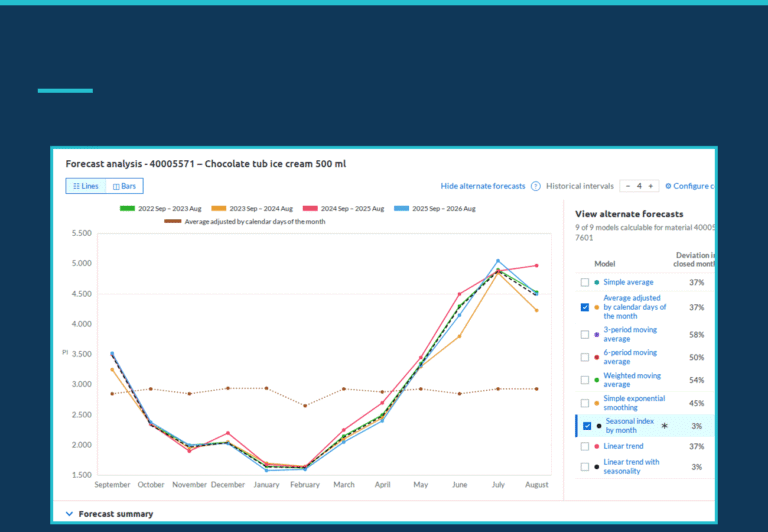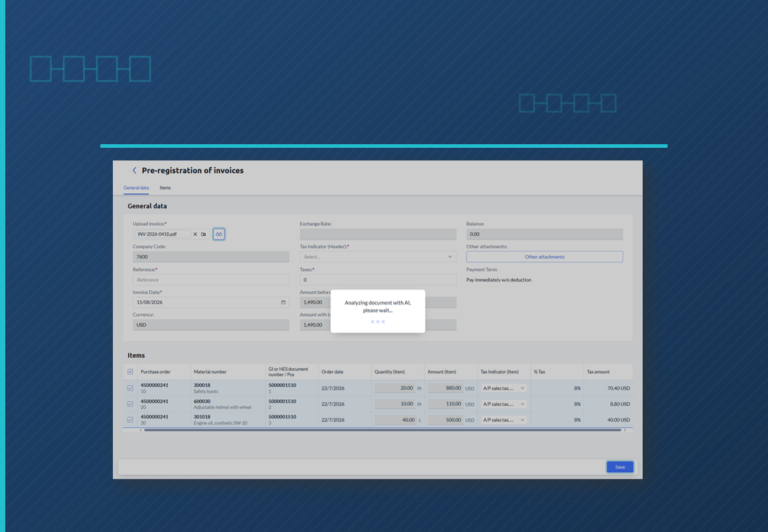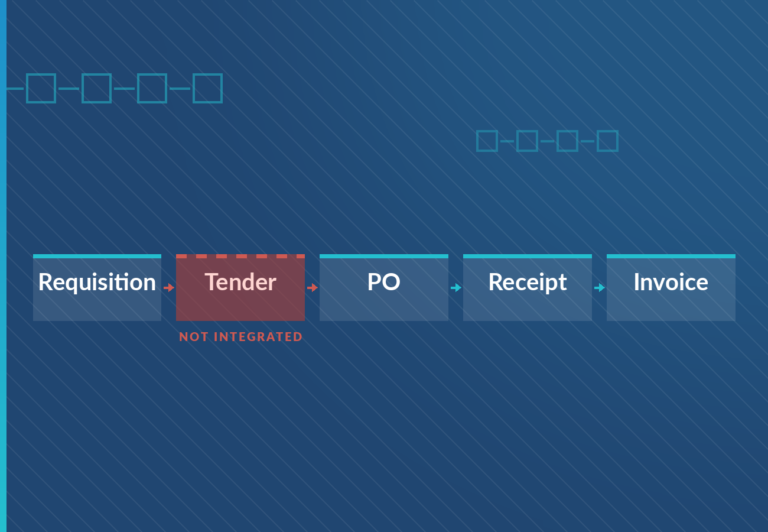




When sourcing and early negotiation happen outside SAP, traceability breaks and financial and regulatory risk climbs. Optimizing the procurement cycle requires unifying requests for quotations directly within the transactional core of the system.
Below, we will address key concepts you need to know to face this new reality and technically analyze how to centralize sourcing by eradicating the use of emails and local spreadsheets, providing a solution that is simple to both use and implement.
What is Smart Procurement in SAP?
Intelligent sourcing is not an abstract marketing concept or a cosmetic layer over the user interface, but the real capability to bring the entire sourcing and negotiation cycle into the transactional environment where your suppliers, materials, cost centers, and purchase orders already live in SAP. In practice, that means bidder interactions and core ERP processes stop living in separate worlds — commercial negotiation and the official record of technical documents finally sit in the same place.
By implementing integrated solutions like SiGO and SiTRACK, organizations ensure that initial inquiries operate directly on the company’s central database, without the need to duplicate records or resort to complex interfaces. This completely changes the rules of the game on how to manage tenders in SAP, transforming a series of historically manual tasks into a clean, transparent workflow with far less manual effort for operations management and the compliance department.
The Pain Point: Your Last Tender Lives in an Excel Sheet That No One Can Audit
The operational reality of many purchasing departments is marked by a highly fragmented scenario: supplier quotations are received dispersedly via email, forcing the buyer to manually consolidate that information into local Excel files containing multiple tabs.
This working model hinders process management and causes a large part of the knowledge generated during the negotiation, as well as the criteria used for award decisions, to remain scattered across email threads and local files that are difficult to access and track.
The weaknesses of this model come to light when the time comes for an audit, a quality inspection, or any regulatory review process. At that exact moment, the system is totally incapable of displaying an unalterable digital trail that technically justifies why a specific supplier won or under which weighted criteria competing proposals were rejected. This lack of transparency weakens process control, violates the principles of segregation of duties (SoD), and leaves the organization unprotected against any regulatory review, turning the purchasing process into a weak link for the business.
What Every Tender Outside SAP Is Costing You
Managing strategic procurement outside SAP generates extra costs and severe time inefficiencies. Manually transcribing quotations from email threads into the ERP consumes valuable working hours and increases the risk of introducing errors in prices or units of measure (UoM). These data errors cause delays in goods receipt (GR) and blocks during invoice verification.
Furthermore, receiving supplier bids in non-standardized formats prevents agile comparison, creating bottlenecks that slow down the supply chain. The real enemy of productivity is the operational friction tolerated by allowing critical information flows to live in isolation.
The fix is to manage sourcing with tools built for it — tools that let you compare supplier quotes on equal terms, protect your margins, and keep inventory data reliable.
What About Ariba? When It Makes Sense and When It Is Too Much
SAP Ariba is a cloud suite designed to cover global procurement processes in large multinational corporations with complex purchasing structures and enterprise-scale supply chains. However, for mid-market organizations or companies outside the public sector, it can be an excessively complex and costly solution.
Operating as a cloud platform completely separated from the transactional core, SAP Ariba usually means a longer systems-integration project, requiring the development of intermediate connections for continuous field mapping and structured message alignment.
In the daily operations of IT teams, master data synchronization between both environments is not always seamless, which can lead to temporary inconsistencies in supplier master tables or material master tables (MARA), while also requiring its own independent licensing scheme that raises the Total Cost of Ownership (TCO).
For a company seeking immediacy and control without intermediate software layers, the complete flow can live perfectly integrated within its current environment. This approach positions native solutions—like those we offer at Innova—as the most efficient Ariba alternative for mid-size companies on the market and demonstrates the viability of executing a clean RFQ process in SAP without Ariba.
From Comparing 3 Prices to Serious Tendering, Straight Inside SAP
Strategic sourcing is a broad operational spectrum, and a company’s tools must possess the technical capability to cover everything from the simplest and most direct requests for quotations to complex tendering processes involving multiple commercial and regulatory variables. This inflection point is precisely where the integration of specialized solutions like SiGO and SiTRACK redefines the operational efficiency of the purchasing department.
Our methodology eliminates traditional dispersion by unifying all negotiation phases within the ERP’s central database, allowing the transactional flow to progress cleanly, securely, and in a fully auditable manner through the following operational milestones:
RFI/RFQ with Supplier Participation
It starts at the source of the information, allowing the supplier to interact directly through a secure web portal by entering their commercial data into a structured form, instead of submitting a PDF document or an informal email. This design completely eliminates manual transcription rework and ensures data homogeneity from the very first moment.
Because the data is captured in a structured way, comparing supplier quotes becomes far easier. The procurement team works with clean data that is ready for analysis inside SAP.
Evaluation Matrix and Recommended Winner
Each tender is scored on an evaluation matrix that mirrors how you actually buy. Criteria can be technical or commercial, and each one can be scored automatically or entered manually. To save setup time, SiGO proposes a matrix based on the category of goods or services being purchased, which the team can then adjust.
Every bidder receives a technical score, a commercial score, and a combined total, making proposals easy to compare on equal terms. The scoring supports the decision, but the final call always stays with the buyer — and the full process leaves an auditable trail inside SAP.
From Winner to Purchase Order, Without Re-transcribing
Once the optimal bidder is selected in the evaluation matrix, the system uses standard SAP BAPIs to convert the winning quotation into a purchase requisition (PR) or a firm purchase order (PO).
All agreed commercial conditions—including scale pricing and Incoterms—are transferred exactly to the purchasing standard tables. This removes re-keying, which eliminates operational errors, drastically reduces cycle times, and stands as the ultimate technical argument that convinces both purchasing directors and compliance officers, demonstrating the reliability of executing an entire RFQ process in SAP without Ariba.
Adapts to Your SAP Architecture in 4–8 Weeks
Our solution offers total technological flexibility by being compatible with both SAP ECC (from version 6.0 onwards) and SAP S/4HANA, safeguarding the enterprise’s investment ahead of future migrations. Its deployment adapts completely to the organization’s existing infrastructure, whether running on SAP Fiori, SAP BTP, or web servers, without imposing any mandatory technical prerequisites.
Being developed under the SAP PartnerEdge framework and holding official certification, the tool is cleanly installed via standard transport orders that respect the ERP’s native BAPIs, ensuring system stability. This enables achieving go-live within an agile timeframe of 4 to 8 weeks.
Furthermore, it is commercialized under a transparent one-time payment or annual subscription model, with no additional costs for user volume, company codes (Bukrs), or registered suppliers.
Frequently Asked Questions (FAQ)
Is it strictly necessary to have the SAP Ariba suite to execute structured tenders in my ERP?
No, absolutely not. For mid-size companies, the entire operational flow of requests for quotations (RFQ) and requests for information (RFI) can be resolved natively within the traditional ERP itself. This provides a highly efficient and cost-effective Ariba alternative for mid-size companies, avoiding the need to undertake complex external systems integration projects and high maintenance overheads.
Can I use this smart procurement solution if my company does not have SAP Fiori implemented?
Yes, compatibility with your current infrastructure is total. The tool has been designed with a flexible architecture that allows it to operate with the same transactional reliability whether the organization uses modern SAP Fiori or SAP BTP interfaces, or continues managing its daily operations through the classic SAP GUI environment, ensuring that current technology is never an operational barrier.
Is there any additional cost based on the volume of external suppliers accessing the web platform to submit their quotes?
No, the commercial model eliminates any volume-based penalties. Thanks to an architecture that isolates the transactional core using a secure intermediate database, external suppliers do not consume direct SAP licenses. The solution is implemented under a fixed one-time payment or annual fee modality, allowing the registration of an unlimited volume of suppliers without hidden costs.
Optimize Your Purchasing Department Today: Request a Personalized Technical Demonstration
Discover alongside our team of senior consultants how to manage tenders in SAP, definitively eradicating the use of emails and spreadsheets with our SiGO and SiTRACK solutions:

We Went Live with AUSAPE on July 14th — Here’s What Happened
We walked through the complete operational journey inside SAP, step by step: from validating master data at onboarding to registering the final invoice. If you missed it, the recap covers the full route and the screens behind each stop.