It’s 9 a.m. and you already have three emails asking the same thing: “where’s my order?” You open SAP, jump from ME2N to ME23N, then MIGO, then MIRO. You copy four numbers into a spreadsheet only you understand. You call the supplier. You reply to the emails with “I’m looking into it.” And tomorrow, all over again.
If that sounds familiar, it’s not your fault or your team’s. It’s a P2P traceability problem in SAP: the entire purchasing cycle lives inside the system, but the end-to-end view isn’t on any single screen. So the real tracking ends up where it shouldn’t: in email and in a shadow spreadsheet.
This article is about getting that view back. What P2P traceability is, where standard visibility breaks down, the three buying scenarios a healthy process must distinguish, what the status quo really costs, and how to solve it inside SAP. It’s also “stop 3” of the webinar we ran with AUSAPE (Spain’s SAP user group), “El camino del lote” — The Batch’s Journey (July 14, 2026, with the Life Science working group): following a batch end to end without ever leaving the ERP.
What is P2P traceability in SAP?
P2P (procure-to-pay) traceability means following every requisition, purchase order, goods receipt and invoice end to end inside SAP, with full status visibility and audit trail. Without it, tracking happens in email and spreadsheets, with errors and blind decisions.
Put differently: it’s being able to answer “where is this?” in one click, with live SAP data, for any document in the purchasing cycle and for anyone who needs it — the requester, the buyer, logistics or finance. Better still: they can check it themselves, one click away, with explanatory comments on each process and up-to-date data on every shipment, for example.
The pain: where standard P2P visibility breaks down in SAP
SAP does its job well. The procure-to-pay cycle is integrated end to end: requisition, approval, purchase order (ME21N), goods receipt (MIGO) and invoice verification (MIRO), all linked to FI. The problem isn’t missing data. It’s that the data is scattered across disconnected transactions, and none of them shows you the whole movie.
Each role sees only its own slice. The requester sees their requisition, but not the PO it generated. The buyer sees the PO, but not the goods receipt. Logistics posts the receipt, but doesn’t know whether the invoice was entered. It’s a fragmented view of an integrated process, and it breaks coordination.
Add the classics:
- No single real-time board. To know whether a requisition is stuck, a PO unreceived or an invoice pending, you navigate several transactions and reports (ME2N, ME2M, ME5A, MB51…) and cross-check them by hand.
- Standard reports fall short. The SAP Community is full of questions about pulling actual delivery dates in ME2N/ME2L or tracing a PO’s history — solved with tricks, variants and “scope of list”, not with a view designed for the buyer.
- Supplier communication lives outside SAP. Delay notices, confirmations and corrections travel by email, with no trace inside the document.
The result is predictable: the buyer becomes a full-time status chaser, and the only “integrated view” in existence is a spreadsheet someone maintains by hand.
What real end-to-end traceability requires
Having the data in SAP is one thing; having traceability is another. Real traceability means the same process — and every document in it — is visible and consistent at every stage, with its status and audit trail. If you have to reconstruct the journey by hand, you don’t have traceability: you have archaeology.
Quick checklist. Real P2P traceability delivers:
- A single document-to-document thread. Requisition → PO → goods receipt → invoice, linked automatically, with no manual reassembly.
- A clear status at every stage. At a glance: pending release, delivered and awaiting invoice, or already invoiced.
- A complete audit trail. Who did what, when and why — no fields edited without a trace.
- A view per role. The requester checks their own process without calling procurement.
- Everything inside SAP. One source of truth, not a copy in Excel.
The extreme case that makes it obvious is pharma and GxP environments. There, batch traceability isn’t an operational nice-to-have: it’s a regulatory requirement. The GxP chain of custody demands documenting every material from receipt, and FDA 21 CFR Part 11 formalizes it in §11.10(e), which mandates, in its own words, the “use of secure, computer-generated, time-stamped audit trails to independently record the date and time of operator entries and actions that create, modify, or delete electronic records,” adding that “record changes shall not obscure previously recorded information.” A batch “tracked in a spreadsheet” is, quite simply, a batch you cannot defend in an inspection. That is exactly the thread of “The Batch’s Journey”: if the purchasing process can be followed end to end — including the batch that arrives at goods receipt — without leaving SAP, compliance stops being a last-minute scramble.
And what holds for pharma as the limit case holds for everyone: food and beverage, chemicals, mining, oil & gas, agribusiness, construction or utilities. The names change; the pain doesn’t.
The 3 buying scenarios a healthy P2P must distinguish
Not all purchases are equal, and treating them as if they were is a major source of friction. A healthy process distinguishes — at least — three paths, giving each the traceability it deserves:
Scenario 1
Framework contract → direct conversion to PO. Terms and prices are already negotiated in an outline agreement. Nothing to reinvent here: the requisition should convert into a PO against the contract, almost frictionless, leveraging what was agreed. The focus is speed and never losing the link to the contract.
Scenario 2
Recurring supplier → direct assignment. The source of supply is clear (info record, source list, usual supplier). The right path is direct assignment and fast conversion — no need to run a competition for something that doesn’t require one. The focus is not bureaucratizing the simple.
Scenario 3
Tender → auditable process. No fixed supplier, high value, or policy requires it. Time to request quotes, compare them against clear criteria and award defensibly. The focus here is the audit: who bid what, which criteria were used, and why the winner won.
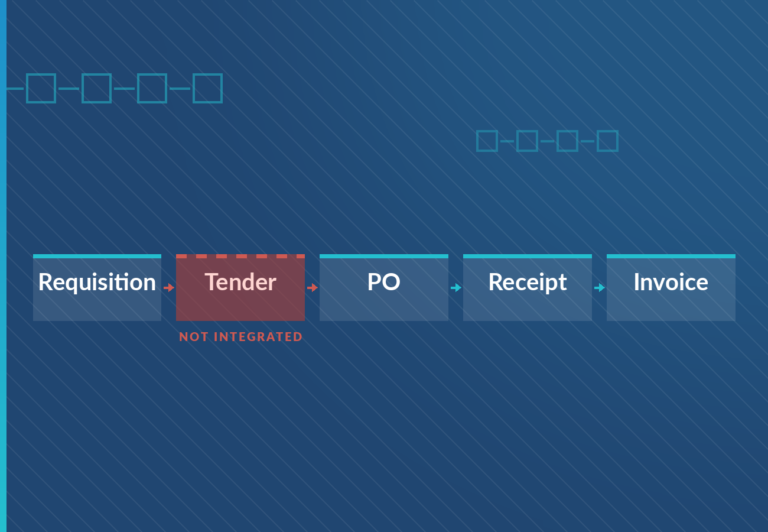
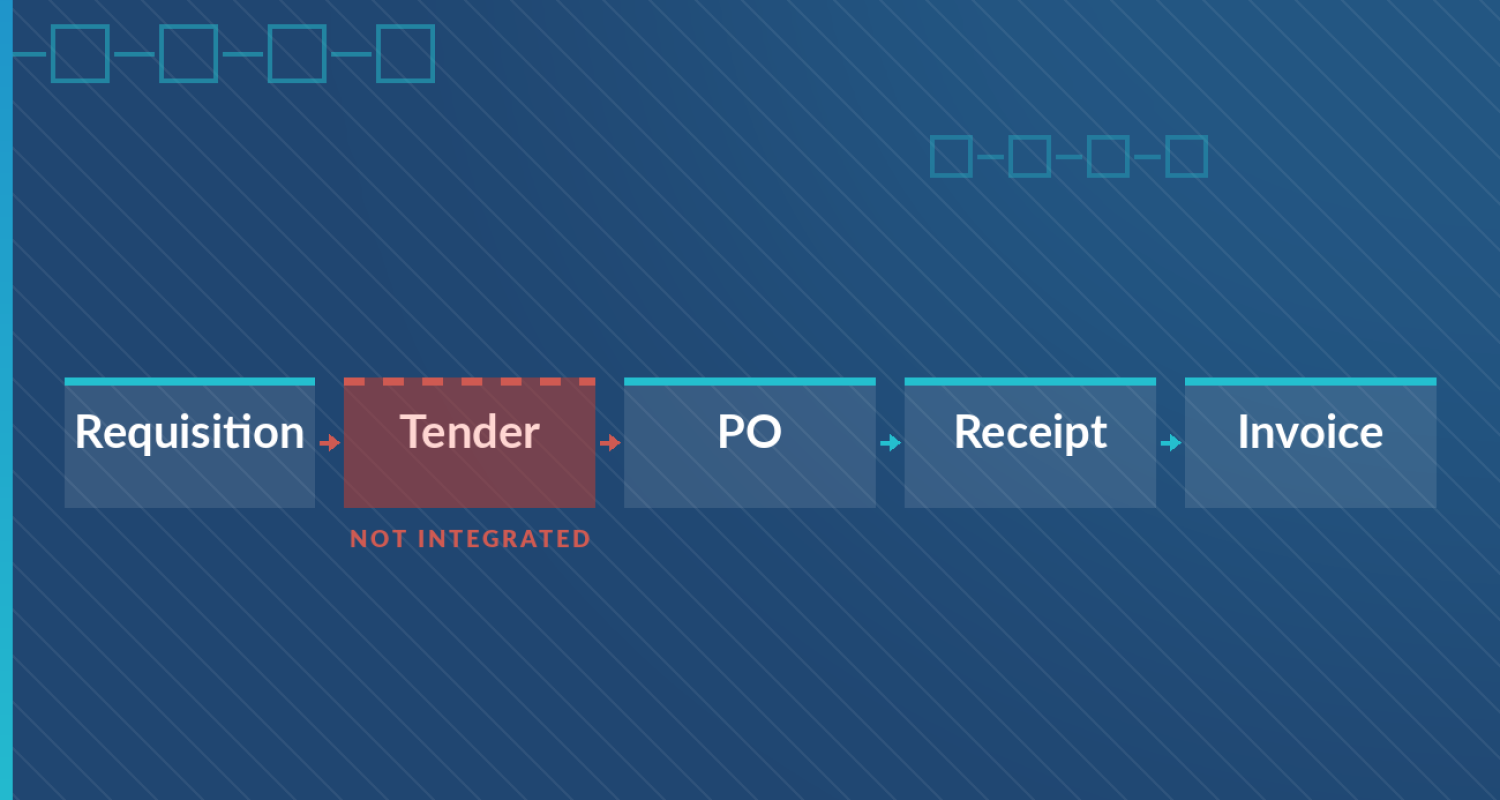
The problem with the standard isn’t that it can’t support these scenarios — it’s that the tender, the most demanding one, usually ends up in spreadsheets and email, disconnected from the SAP documents. And that’s where the mess begins.
The hidden cost of the status quo
“Chasing statuses” sounds like a minor problem. Added up over a year, it isn’t. These are the real costs of running P2P on email and spreadsheets:
Rekeying errors. Every value copied by hand from one screen to another — or from SAP into a spreadsheet and back — is a chance for error. Raymond Panko’s reference research on human data-entry error, together with classic studies of expert operators from the 1980s and 90s, puts the floor at a 0.5–1% error rate per field even under controlled conditions with verification; in real conditions (fatigue, pressure, varied documents) it rises to 3–4%. A purchase order has dozens of fields; do the math and you’ll see why quantity discrepancies, wrong dates and mismatched invoices keep appearing.
Blind decisions. Without a consolidated view, approvals and purchases happen on incomplete information. You don’t see available budget, price history or risk alerts at the moment of decision. The result: worse buying decisions, made late.
Painful audits. When traceability lives in emails and loose spreadsheets, every audit is an excavation. In regulated environments, a gap in the audit trail isn’t an inconvenience — it’s a finding.
Buyers’ time lost. The most silent cost. Your senior procurement people, who should be negotiating and finding savings, spend the day answering “where’s my order?”. And the cost doesn’t stop upstream: downstream, processing a single invoice isn’t free. According to Ardent Partners, “Accounts Payable Metrics That Matter in 2025” (based on 212 accounts payable professionals), the average cost of processing one invoice is $9.40, versus just $2.78 at best-in-class organizations. Manual processes explain the gap: the same report puts the average cycle at 9.2 days (3.1 days for the best versus 17.4 for the rest) and the average exception rate at 22%, versus 9% for best-in-class. Every exception — every invoice held up by a mismatched value — pushes that number up.
The conclusion is uncomfortable but simple: the shadow spreadsheet isn’t free. You pay for it in errors, time and risk.
What about a procurement suite? The two-system problem
A fair objection: “a suite like SAP Ariba or Coupa solves this.” That depends on what you mean by “solve.” These are powerful platforms, but they share an architectural trait worth understanding before you sign: they live outside the ERP. Requisitioning and approval typically happen in the cloud; goods receipt, posting and payment still happen in SAP. The process is split across two systems that must be kept in sync through integrations (CIG, adapters, middleware).
And that synchronization is not a footnote:
- Coupa itself acknowledges it in its technical material: no SAP ERP integration is ever truly “plug-and-play”, even if best practices make it more predictable.
- For SAP Ariba integrated with ECC/S/4HANA, SAP’s documentation describes that status imports can run in batch depending on the channel — that is, not always in real time.
- Integrators document what happens when things fall out of sync: stalled approvals, invoices in limbo, failed postings in the ERP; and custom processes (Z fields, local extensions) clash with a highly standardized integration.
- If the supplier doesn’t adopt the portal, the flow lands right back where it started: email, phone and spreadsheets.
None of this disqualifies those suites (Ariba is, in fact, SAP’s own and part of the same ecosystem). But it does qualify the promise: buying a suite does not automatically equal end-to-end traceability. You can end up with half the thread in the cloud and half in the ERP, joined by an integration you have to build, test and maintain. The logical alternative: let traceability live where the documents already live — inside SAP.
How SiTRACK solves it: end-to-end visibility inside SAP
Up to here, everything applies regardless of tooling. The question is how to get the view back without taking the data out of SAP and without an endless project. That’s exactly what SiTRACK does.
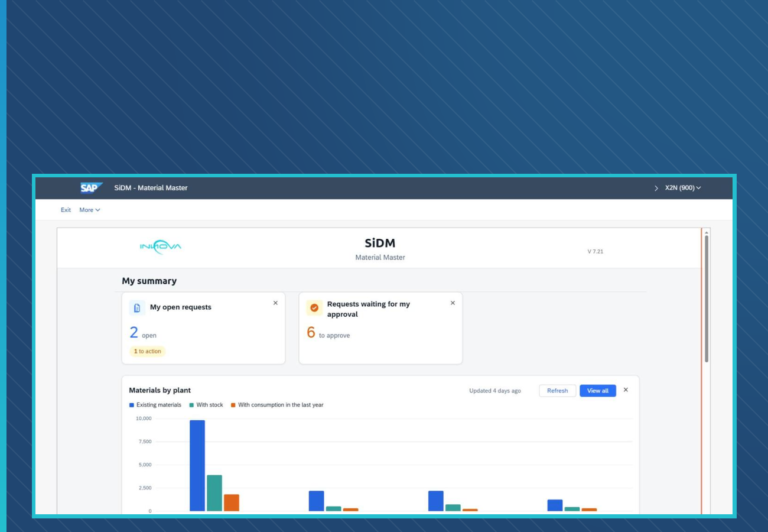
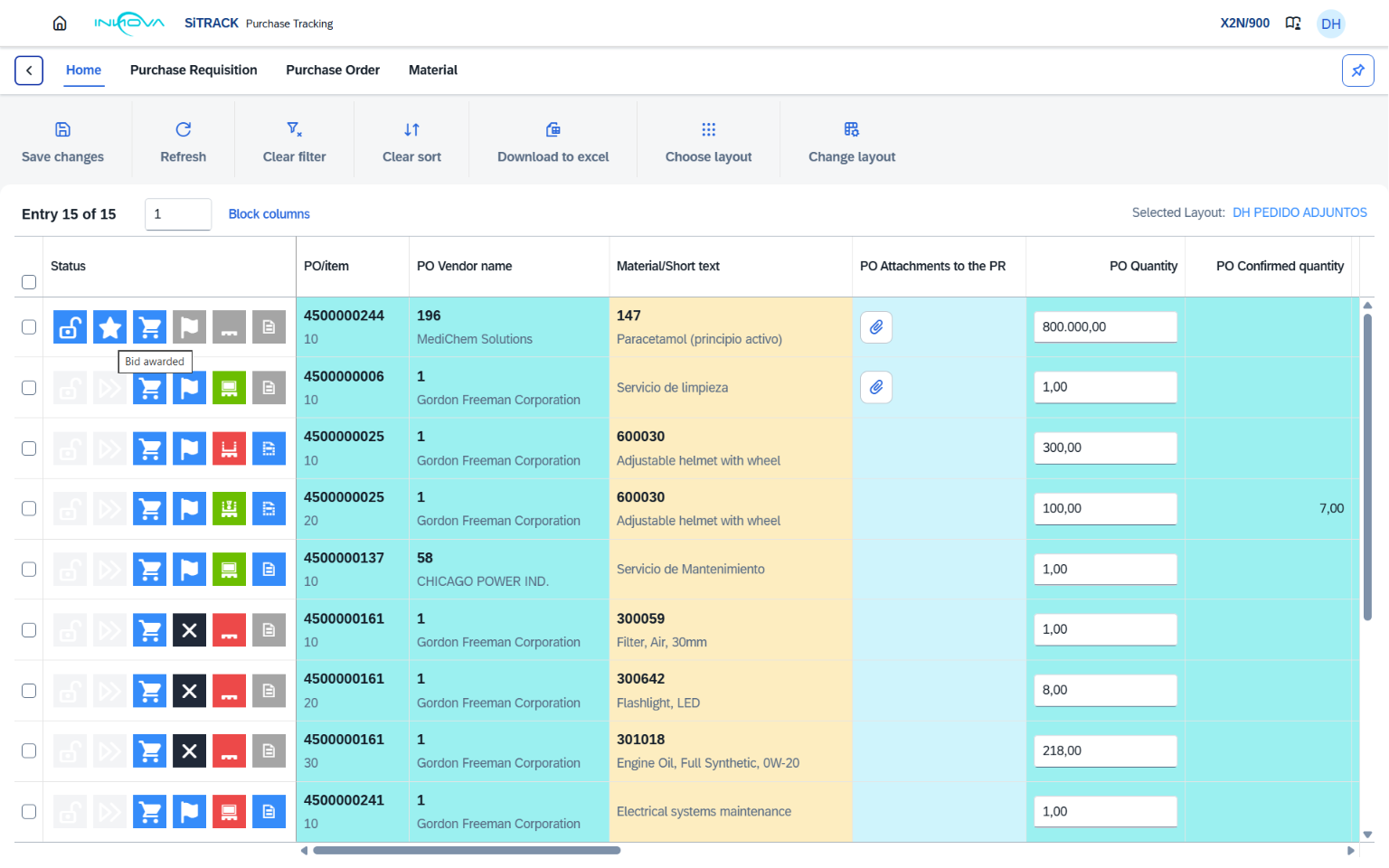
SiTRACK gives the entire P2P cycle a single, live view inside SAP. It automatically links requisition, purchase order, goods receipt and invoice, and shows each process’s status with clear icons: what’s pending release, what’s been delivered and awaits an invoice, which invoice has already been entered. Everyone — from requester to finance — sees the same status in real time, with information read live from SAP (no external database, no cross-system synchronization).
What SiTRACK does, concretely:
- Customizable statuses to fit your operation — for example, import tracking, with logistics milestones such as ETD, ETA and container status integrated via connections to platforms like Searates.
- Mass processing of purchasing processes: assigning buyers to requisitions, changing delivery dates, returning requisitions with corrections — without breaking deadlines or release strategies.
- Supplier notifications for pending or delayed deliveries, with the trail kept inside the document instead of lost in an inbox.
- More than a dozen OTIF indicators (on time, in full) to evaluate suppliers with real data.
- Requisition return instead of the standard’s rigid “reject and recreate,” which loses traceability and duplicates work.
And the tender? When a requisition needs scenario 3 — requesting quotes and awarding auditably — it jumps straight into SiGO, which centralizes bid and tender management integrated with SAP, on the purchase documents themselves (supporting RFI, RFQ and RFP). SiGO lets you send the request to several suppliers at once, receive structured proposals, compare them with an evaluation matrix of technical and commercial criteria, select the winner and generate the PO — all with full traceability and a defensible award. From SiTRACK you watch that tender progress as it happens, without losing the thread. That way, the three buying scenarios coexist in one flow: framework contract and recurring supplier down the fast lane; tender down the auditable one.
All of this runs on SAP ECC and S/4HANA, with no per-user or per-company fees and a typical go-live in 4–8 weeks. Innova Apps is an SAP PartnerEdge partner with one SAP-certified app; we’ve spent more than 12 years building these apps, now used by more than 150 companies. We don’t replace SAP — we remove its friction.
This is what we showed in the AUSAPE webinar “The Batch’s Journey”: following a real batch from requisition to invoice without opening a single spreadsheet. If you missed stop 3, you can watch it here: The Batch’s Journey webinar (recording in Spanish).
And if you want the full picture of the procure-to-pay cycle and its bottlenecks, we have a reference piece: SAP P2P.
Stop chasing statuses by hand. In 30–45 minutes we’ll show you your purchasing cycle on a single screen.
Frequently asked questions
How do you manage a tender inside SAP?
With SAP MM you can create RFQs and compare prices (for example with ME49), but the standard module doesn’t handle complex tenders well end to end. The way to manage them without taking the process out of SAP — without spreadsheets or email — is to extend MM with a tool like SiGO: send the request to several suppliers, receive structured bids, evaluate them with a matrix of technical and commercial criteria, award auditably and generate the PO, all with full traceability on the SAP documents.
Do I need SAP Ariba or Coupa for P2P traceability?
Not necessarily. Ariba and Coupa are cloud suites that run outside the ERP: part of the process lives on the platform and part in SAP, kept in sync through integrations. If your purchasing documents already live in SAP (ECC or S/4HANA), an app like SiTRACK delivers end-to-end traceability inside the system itself, with no cross-platform synchronization.
Is P2P traceability useful outside pharma?
Yes. Pharma and GxP are the extreme case because of regulatory demands, but the same traceability cuts friction in manufacturing, food and beverage, mining, construction, oil & gas, agribusiness, chemicals and utilities.
Do the data have to leave SAP?
No. SiTRACK reads information live from SAP and actions run in the system itself. There is no external database and no parallel copy.
Stop chasing statuses
P2P traceability isn’t a luxury: it’s getting out of email and out of the shadow spreadsheet. It’s buyers buying again instead of tracking, requesters checking for themselves, and the whole process being traceable from requisition to invoice — and defensible in front of whoever asks — without leaving SAP.
Want to see it with your own processes? Book a SiTRACK demo. In 30–45 minutes we’ll show you what your purchasing cycle looks like when it finally fits on one screen.
Your purchasing cycle, on one screen. A demo with your own processes, no strings attached.