
Creation flow and structured text
USE CASE SiDM Materials
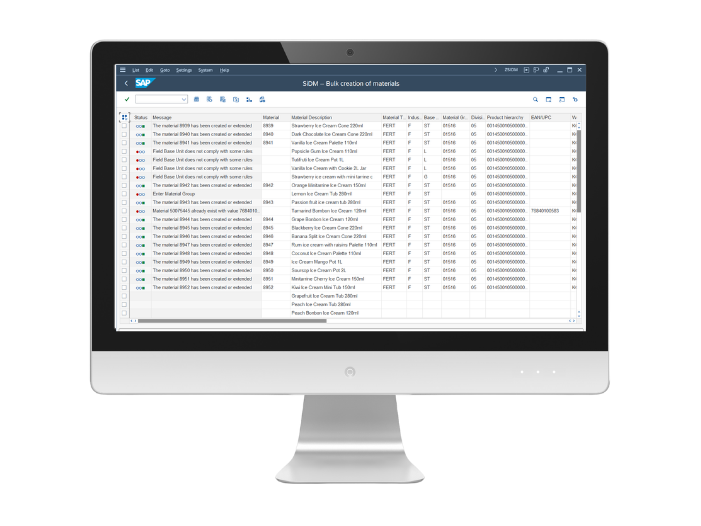
In SAP standard, material registration often depends on transactions such as MM01/MM02 (or complex configurations in MDG), which forces requesting users to know too many fields, views and technical criteria. This results in incomplete requests, inconsistent free texts and loops between areas to complete data, with a direct impact on material master quality and registration times.
Additionally, when the process requires approval or participation from multiple areas, it is common to end up with “manual” controls (mail, Excel) or workflows that are difficult to maintain, with typical problems such as misdetermined participants, lack of traceability, and materials created with incomplete extensions/views for the required organizational units.
Do you identify with any of these cases?
- How can I implement an approval flow for the registration of materials in SAP so that they are not “active” until they are approved?
- How do I enable a “Request Material” type experience for users who are not master data proficient, without exposing them to MM01/MM02?
- How to define each participant and their role within the workflow (who fills which data)?
- How do I make each area fill in only its own fields (purchasing, quality, finance, logistics) and respect segregation of duties?
- How do I manage returns and corrections (resend to the requester) without losing traceability of the process?
- How do I ensure that the descriptive text of the material remains consistent (structure, nomenclature) and does not depend on “how everyone writes it”?
- How do I reduce rework due to incomplete data (views, organizational units, units of measure, classification) before creating/extending the material?
- How do I trigger notifications by mail to each participant when it is his turn to act in the flow?
Solution
Solution – SiDM Materials
SiDM Materials enables workflows and request control to manage the creation and maintenance of the material master in SAP, involving all key areas, improving control and accuracy.
How it solves it:
- Tailor-made flow design: the company defines different flows, the number of participants and which information completes or approves each role (e.g.: requester → purchasing → quality → finance → master data).
- Simplified request for the applicant: the user creates a registration request by completing only the minimum fields defined by the organization, with request text/comments to justify the registration (the know-how is embedded in rules and process, not in manuals).
- Classification and features as a basis for the text: the applicant (and/or the areas) can complete features that are then used to standardize information and speed up the construction of the text of the material.
- Notifications and process sequence: once the request is sent, the next participant receives a notification of his task and the process continues in stages, ensuring traceability and control.
- Rules for completion and standardization: participants can use rules to support automatic completion and maintain consistency (e.g., text/field rules and adoption of internal best practices).
- Return or reject: the flow contemplates return to the requester for correction or rejection when applicable, maintaining control of the process.
- Master data controlled creation: the last participant (e.g., master data leader/team) executes the creation of the material ensuring that: critical fields are correct, the material is created with the necessary views and extended to organizational units

Do you identify with any of these cases?
Common SAP problems solved by SiTRACK

Tenders in SAP without Excel or email: what intelligent sourcing looks like
Enjoy the Audio Version of the Article! When sourcing and early negotiation happen outside SAP, traceability breaks and financial and regulatory risk climbs. Optimizing the procurement cycle requires unifying requests for quotations directly within the transactional core of the system. Below, we will address key concepts you need to know to face this new reality […]

MRP Planning in SAP for Agribusiness: Stop Planning Your Next Campaign in Excel
Enjoy the Audio Version of the Article! In the agribusiness industry, those of us operating within SAP environments understand that planning is not a theoretical office exercise. It is a critical race against the clock, dictated by uncontrollable crop cycles, highly perishable products, and extremely narrow harvesting windows. In our experience, we have observed that […]

SAP Best Practices for Mining: How to Prevent Stockouts and Protect Operational Continuity
Enjoy the Audio Version of the Article! Organizations often make the mistake of thinking that stockouts are exclusively a failure of planning algorithms. However, in our experience, the root of these shortages usually lies in the lack of alignment between actual field consumption, Master Data integrity, and the agility of procurement processes in geographically distributed […]
Read more about solutions for SAP

Schedule your DEMO
Easy to know.
In 30 – 45 minutes we present you our solutions, online.
So you can see in detail how your processes will be optimized in SAP.
