Some purchases are settled with three phone calls. Others should not be awarded without a signed record. The silent mistake in most procurement teams isn’t negotiating badly: it’s using the same instrument for both.
Which sourcing model fits which purchase?
The choice depends on three variables: how closed the specification is, how many capable suppliers the market holds, and how much technical criteria weigh against price. With a closed specification and enough competition, a request for quotation or a reverse auction is enough; when technical criteria matter, you need a tender with weighted evaluation and sealed-envelope opening.
Buying everything the same way costs you twice
A team that only knows how to run formal tenders takes six weeks to buy a set of bearings. A team that only knows how to email three suppliers awards a three-year freight contract on a price table and no technical evaluation.
Both cost money. The first in hours and delays; the second in a supplier who wins on price and fails on service. Neither is fixed by more discipline: it’s fixed by having several instruments and knowing which one the purchase calls for.
Four instruments, four different jobs
| Instrument | When it fits | What it solves | What happens if you force it |
|---|---|---|---|
| Supplier preselection (RFI) | You don’t yet know who can serve you, or the panel hasn’t been refreshed in years | Qualifies and widens the market before you ask for a price | Skip it and you keep quoting the same three suppliers |
| Simple request for quotation | Closed specification, moderate value, three approved suppliers | A comparable price, fast, with minimum traceability | Use it on a complex purchase and you decide without evaluating the technical side |
| Reverse auction | Identical specification for everyone, three or four capable suppliers, volume that justifies the preparation | Squeezes the price through live competition | If technical criteria weigh, you buy cheaply something you cannot execute |
| Tender with technical and commercial evaluation | Weighted technical criteria, indirect costs, several currencies, split awards by line, or an award you will have to defend | Decides on weighted criteria and leaves the process documented | Use it to buy consumables and the process costs more than the saving |
Preselection. The least used instrument and the one that changes the outcome most. Much of a purchase’s saving is decided before anyone asks for a price: in how many capable suppliers are inside. A panel closed for five years doesn’t compete, it negotiates.
Simple request for quotation. Three bids, one table, one decision. It works perfectly for most recurring spend, and pretending otherwise is bureaucracy. The one thing it shouldn’t lose is the trail: who was invited, what they bid, and where the purchase order price came from.
Reverse auction. Invited suppliers bid downwards inside a fixed window. Each sees whether they are in the lead and how long is left to improve, not the other bidders’ prices. It fits commodities, freight, consumables and standardised services. Badly designed, it doesn’t generate savings: it generates unsustainable bids that end in renegotiation.
Full tender. Approved terms, criteria and weights fixed before inviting, a window for commercial, technical and legal questions with a deadline, sealed-envelope opening and a weighted evaluation matrix. It is expensive in effort and it is the only one that holds up in an audit three years later.
Sealed envelope isn’t an instrument: it’s a guarantee you add
Sealed-envelope opening means bids stay inaccessible — to the buyer, to the category lead, to whoever administers the system — until an authorised user executes the opening, with a record of who and when.
It isn’t only control. It has a commercial effect: when a supplier knows nobody will see their number early, they sharpen their pencil on the first round. A process without guaranteed confidentiality teaches the market to hold margin back for the second.
That is why the combination that works best on large purchases is sealed envelope first, auction second: the sealed round sets honest starting prices and qualifies suppliers technically, and the bidding opens only to those who cleared the technical bar, on the commercial variable.
The real problem isn’t choosing badly: it’s not being able to choose
In most organisations each instrument lives somewhere else. The request for quotation, in email. The auction, on a platform contracted separately. The tender, in a shared folder with the terms in Word and the comparison in Excel. And the purchase order, in SAP, typed in by hand at the end.
| Each instrument on its own | All of them inside SAP | |
|---|---|---|
| Choosing the model | You use whichever the available tool allows | You use whichever the purchase calls for |
| Starting data | Re-keyed into every tool | Comes from the purchase requisition and the master |
| Traceability | Spread across three systems and a mailbox | One file per process |
| End of the process | An email naming the winner | Purchase order or contract created from the winning bid |
| Measuring savings | Rebuilt by hand every quarter | Calculated on its own, against the declared baseline |
It all has to end in the purchase order or the contract
That is the boundary that decides whether the work before it was worth anything. A process that ends in an email naming the winner leaves execution to chance: someone types the price, or doesn’t, or types a different one.
When the purchase order or the outline agreement is created from the winning bid, three things stop being possible: that the executed price isn’t the awarded one, that someone buys off contract unnoticed, and that the file and the execution tell different stories.
Measuring savings: centralised, comparable and auditable
A saving that has to be rebuilt by hand every quarter isn’t a metric: it’s an argument. And almost no argument about savings is about the final price — they are all about the starting point.
| Baseline | When it’s honest | Why it gets abused |
|---|---|---|
| Budgeted amount for the process | Declared when the process is created and carried through to award | Set with room to spare and the saving inflates without anyone lying |
| Last purchase | Repeat buys in a stable market | Ignores a market that came down on its own |
| Material reference price | Materials with a maintained, up-to-date price | If the master is stale, you are measuring fiction |
| Best initial bid | Measures what the negotiation itself contributed | The most flattering one: it almost always gives the biggest number |
The rule that makes any of them defensible is the same: the baseline is declared before suppliers are invited, not chosen after the award.
And there is a second condition, the one that separates a metric from an anecdote: the calculation must be the same across all four instruments and live in a single place. If the auction is measured by its bidding delta, the tender against budget and the quotation against nothing, there is no procurement saving — there are three figures that cannot be added up.
In a reverse auction it is worth keeping both: the delta between the first and last bid — which tells you whether the auction worked as a mechanism — and the awarded price against the declared baseline — which tells you whether the company is paying less than before. A large delta against a flat baseline means suppliers opened high on purpose.
What SiGO does
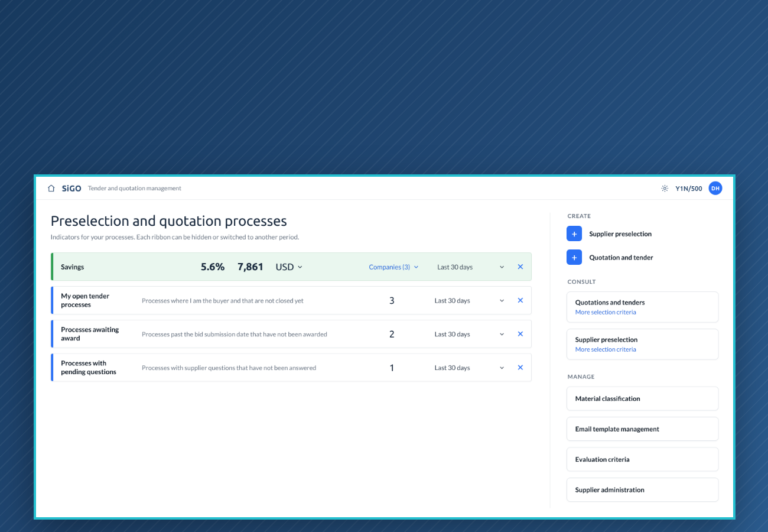
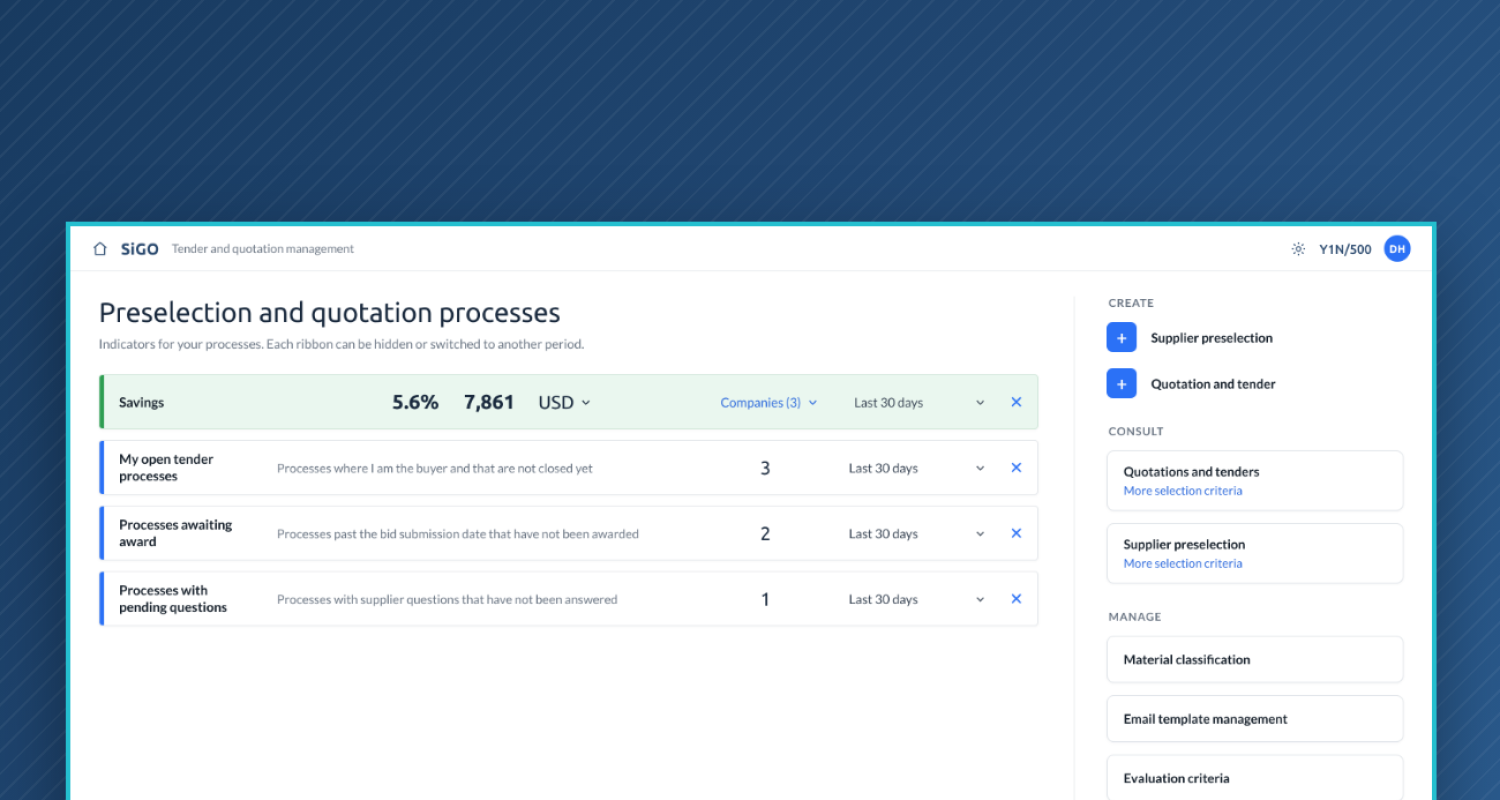
SiGO is tender and quotation management inside SAP: RFI/RFQ, supplier participation, evaluation matrices, winner recommendation and purchase order creation. All four instruments, one file, one way of measuring.
| Key user pain | How SiGO solves it |
|---|---|
| One single way of buying everything | From a simple three-bid comparison to a tender with weighted criteria, in the same application |
| The supplier panel hasn’t been refreshed in years | Preselection processes and supplier suggestion before asking for a price |
| Endless improvement rounds over email | Reverse auction: a downward bidding window showing the supplier’s position, the time left and every bid recorded |
| Anyone can see a bid early | Sealed-envelope opening: bids stay invisible until the authorised user executes the opening, with a record of who and when |
| Comparing bids by hand takes days | Weighted technical and commercial scoring, in a single currency and with indirect costs |
| Awards that are hard to justify in an audit | Criteria and weights fixed before inviting, questions with deadlines, approval of terms and award in SiLI, and a full history of rounds |
| Negotiated savings never reach the purchase order | The SAP purchase order or contract is created from the winning bid, not from re-keyed data |
| Every saving has to be rebuilt to report it | Centralised savings report: what was budgeted, bid, auctioned and awarded, by process and by period |
| Suppliers don’t log into SAP, so prices get re-keyed | Suppliers take part through the portal, on the web or with an Excel template, with no SAP user |
Three details that tend to decide the conversation:
- Suppliers and external evaluators take part without an SAP user. There is no licence to negotiate in order to invite a third party to a round or an auction.
- No per-user or per-company fees. Inviting two more suppliers costs nothing at the margin — and the size of the panel is precisely what determines how much saving is on the table.
- Works on SAP ECC and S/4HANA (all editions except S/4HANA Cloud Public Edition), including on a web server, with no Fiori and no BTP. Live in 4–8 weeks.
Frequently asked questions
When should you use a simple request for quotation and when a full tender?
A request for quotation fits a closed specification, moderate value and already approved suppliers: three comparable bids and a fast decision. A tender with weighted criteria is right when technical criteria matter, there are indirect costs or several currencies, or the award will have to be defended in an audit.
When does a reverse auction make sense?
With an identical specification for every participant, at least three or four capable suppliers and volume that justifies the preparation: commodities, freight, consumables, standardised services. It does not fit when technical criteria weigh as much as price or when real competition is thin.
What is sealed-envelope opening?
It is the mechanism by which bids stay inaccessible to every internal participant until an authorised user executes the opening on the scheduled date, with a record of who and when. It guarantees no bid can be read, compared or leaked before the deadline closes.
Can sealed envelope and reverse auction be combined in the same process?
Yes, and it is the recommended sequence: a sealed round to set starting prices and qualify suppliers technically, then an auction window open only to those who cleared the technical bar, on the commercial variable.
What does a supplier see during a reverse auction?
Whether their bid is currently in the lead, how much time is left before close, and the option to submit a new, improved bid. They do not see the prices submitted by the other participants.
What should the savings of a sourcing process be measured against?
Against a baseline declared before suppliers are invited: the amount budgeted for the process, the last purchase, or the material’s reference price. For the figure to be comparable across processes, the criterion must be the same for every instrument and the calculation must live in a single place.
Do you buy everything the same way because your tool only knows one way? We will show you the four models on screen, from process to purchase order.